Does Ohio have the ban the box law?

Andrew Campbell
Published Jul 13, 2026
Does Ohio have the ban the box law?
The Ohio Senate passed House Bill 56 also known as “Ban the Box” legislation. This bill prohibits public employers from asking for information about an applicant’s felony convictions at the time the application is submitted to the public employer.
What states have ban the box laws 2021?
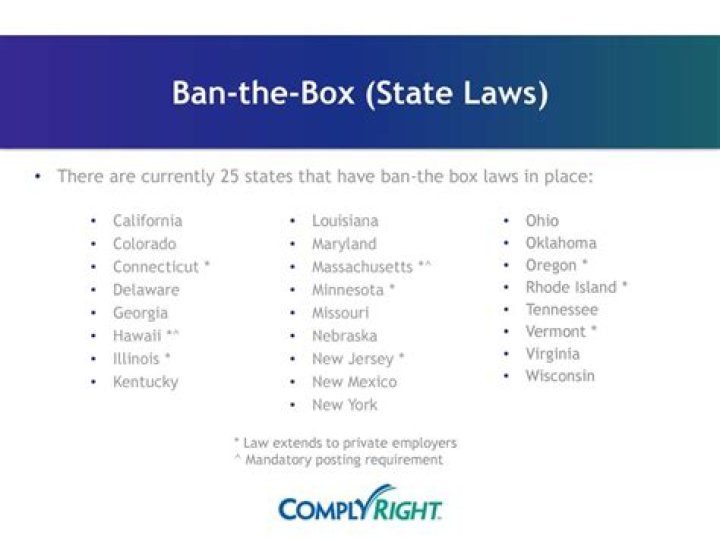
Currently, thirteen states (and the District of Columbia) have ban-the-box laws that apply to private employers—California, Colorado, Connecticut, Hawaii, Illinois, Massachusetts, Minnesota, New Jersey, New Mexico, Oregon, Rhode Island, Vermont, and Washington.
Is ban the box a law?
The federal government embraced “ban the box” for federal agencies and contractors. Effective December 2021, the law will prohibit most federal agencies and contractors from requesting information on a job applicant’s arrest and conviction record until after conditionally offering the job to the applicant.
Who is exempt from ban the box?
1. California’s Ban the Box Law Does Not Apply to Employers with Fewer Than 5 Employees. California’s Ban the Box Law applies to employers with five or more employees. California Government Code § 12952(a). If the employer does not employ at least five people, California’s Ban the Box Law does not apply.
How does ban-the-box affect HR?
In a nutshell, Ban the Box is a generic term used for a law or regulation that essentially prohibits an employer from inquiring about criminal records on an employment application, and in some cases, delays the time in which an employer can inquire about criminal records until later in the hiring process.
Does ban-the-box work?
In a 2018 study from Texas A&M University and the University of Oregon, “The Unintended Consequences of Ban the Box: Statistical Discrimination and Employment Outcomes when Criminal Histories are Hidden,” the researchers found that employment rates dropped by 5.1% for Black men ages 25 to 34 without a college degree …
How does ban the box affect HR?
Does Ban the Box work?
Recent research has shown that although ban the box policies, which delay questions about criminal history and background checks until late in the hiring process, are beneficial for people with criminal records, they can also have unintended consequences on young men of color.
Is ban-the-box effective?
In 2014, research on the effect of Hawaii’s ban the box law showed that, “by mollifying the social stigma attached to a criminal record during the hiring process, Hawaii’s ‘ban the box’ law proved to be extremely successful in attenuating repeat felony offending.”
What is ban-the-box policy?
California’s ban the box law went into effect in 2018. It prohibits employers from asking about criminal history before a job offer has been made. It applies to employers with five or more workers. Once an offer has been made, an employer cannot rescind it simply because of an applicant’s criminal past.
What states follow the 7 year rule background checks?
SEVEN-YEAR STATES: California, Colorado, Kansas, Maryland, Massachusetts, Montana, Nevada, New Hampshire, New Mexico, New York, Texas, and Washington. [In some of these states, the 7-year reporting restriction for convictions only applies if the applicant does not meet a certain salary threshold.
Which states have ban the box laws?
California. California’s ban the box law went into effect in 2018.
What states ban the box?
The 14 states with established Ban the Box laws are: California. Colorado. Connecticut. Delaware. Georgia. Hawaii.
What are ban the box laws?
The “Ban the Box” law is a national movement to change employment applications that discriminate against job applicants who have a criminal conviction in their backgrounds.