How do you calculate after-tax cost of debt for WACC?

Emma Jordan
Published Jul 11, 2026
How do you calculate after-tax cost of debt for WACC?
Take the weighted average current yield to maturity of all outstanding debt then multiply it one minus the tax rate and you have the after-tax cost of debt to be used in the WACC formula.
How do you calculate the weighted average cost of debt?
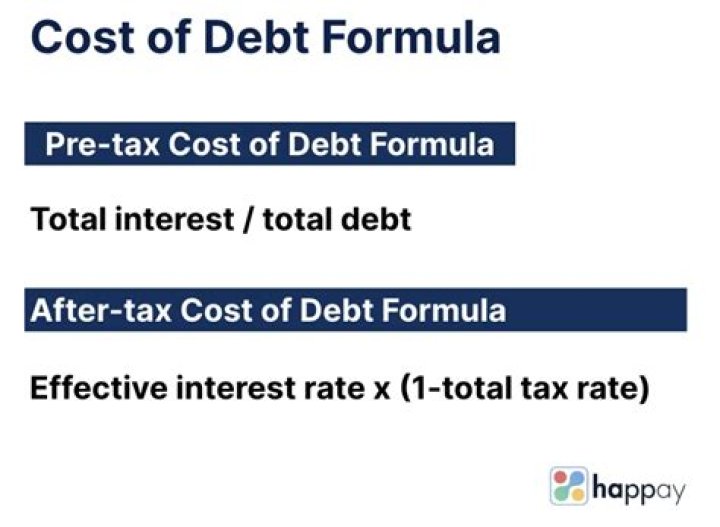
Total interest / total debt = cost of debt To do so, you’ll need to know your effective tax rate. Then add those results together. To calculate the weighted average interest rate, divide your interest number by the total you owe. 6.5% is your weighted average interest rate.
Why is after-tax cost of debt calculated for WACC?
Businesses are able to deduct interest expenses from their taxes. Because of this, the net cost of a company’s debt is the amount of interest it is paying minus the amount it has saved in taxes. This is why Rd (1 – the corporate tax rate) is used to calculate the after-tax cost of debt.
What are the steps to calculate WACC?
WACC Formula = (E/V * Ke) + (D/V) * Kd * (1 – Tax rate)
- E = Market Value of Equity.
- V = Total market value of equity & debt.
- Ke = Cost of Equity.
- D = Market Value of Debt.
- Kd = Cost of Debt.
- Tax Rate = Corporate Tax Rate.
How do you calculate cost of debt in financial management?
Cost of Debt = Interest Expense (1- Tax Rate)
- Cost of Debt = $16,000(1-30%)
- Cost of Debt = $16000(0.7)
- Cost of Debt = $11,200.
How do you calculate cost of debt on financial statements?
Total up all of your debts. You can usually find these under the liabilities section of your company’s balance sheet. Divide the first figure (total interest) by the second (total debt) to get your cost of debt.
What is the weight of debt?
Weight of debt is simply defined as the percentage of debt of the total capital structure of the company. In other words, the weight of debt shows the ratio of debt that is taken on by the company.
Why the after-tax cost of debt is the relevant cost of debt?
The after-tax cost of debt is more relevant because it is the actual cost of debt to the company. The pretax cost of debt is equal to the after-tax cost of debt, so it makes no difference.
Why is the after-tax cost of debt rather than its before tax cost used to calculate the weighted average cost of capital?
The cost of Debt is a rate of interest that a company is paying to its debt security holders. However, this rate is the gross rate and cannot be used in calculating the weighted average cost of capital. The reason behind this is that the interest is a tax-deductible expense.
How do you calculate after-tax cost of debt?
Sum this column for your weighted average cost of debt. Calculate the after-tax rate. As a final step for the cost of debt on companies (debt is tax deductible) take the rate in step 5 and multiply by 1 minus the marginal tax rate: (1 — marginal tax) x (before-tax rate). This is your “after-tax” cost of debt.
How do you calculate the weight of a debt in Excel?
To calculate the weight, take the sum of column C, or the debt amounts. In column D, for “Weight,” divide column C by the sum of column C for the weighting (or average) of each dollar amount. Weights should sum to 1.00.
What is the after-tax cost of debt for a small business?
A business has an outstanding loan with an interest rate of 10%. The firm’s incremental tax rates are 25% for federal taxes and 5% for state taxes, resulting in a total tax rate of 30%. The resulting after-tax cost of debt is 7%, for which the calculation is: 10% before-tax cost of debt x (100% – 30% incremental tax rate)
What is the weighted average cost of capital (WACC)?
What Is the Weighted Average Cost of Capital (WACC)? WACC is the average after-tax cost of a company’s various capital sources, including common stock, preferred stock, bonds, and any other long-term debt. In other words, WACC is the average rate a company expects to pay to finance its assets.