What is the mesolimbic pathway?

Sarah Oconnor
Published Jul 11, 2026
What is the mesolimbic pathway?
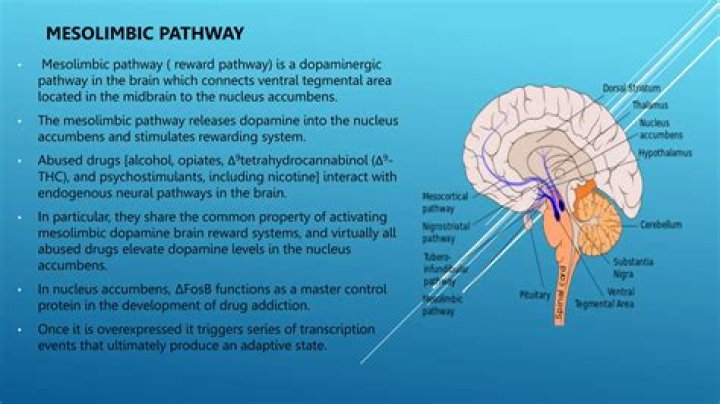
The mesolimbic pathway, sometimes referred to as the reward pathway, is a dopaminergic pathway in the brain. The pathway connects the ventral tegmental area in the midbrain to the ventral striatum of the basal ganglia in the forebrain. The ventral striatum includes the nucleus accumbens and the olfactory tubercle.
What are the 3 dopamine pathways?
The major dopaminergic pathways in the brain include the nigrostriatal, mesolimbic, mesocortical and tuberoinfundibular systems that play vital roles in the regulation of many important physiological functions.
How do I activate my brain reward system?
The reward systems of the brain are a group of structures which are activated whenever we experience something that is rewarding, such as eating a nice tasting food, sex, or using an addictive drug.
How does reward pathway work?
When exposed to a rewarding stimulus, the brain responds by increasing release of the neurotransmitter dopamine and thus the structures associated with the reward system are found along the major dopamine pathways in the brain. The mesolimbic dopamine pathway is thought to play a primary role in the reward system.
What does mesolimbic mean in medicine?
: of, relating to, or being the more central portion of the limbic system of the brain that arises mainly in the ventral tegmental area, consists especially of dopaminergic neurons, and innervates the amygdala, nucleus accumbens, and olfactory tubercle Bupropion, an atypical antidepressant that increases dopamine …
Where does the mesolimbic pathway terminate?
These dopaminergic axons project and primarily terminate in the nucleus accumbens (NAc) in the ventral striatum, but also extend into the amygdala, bed nucleus of stria terminalis (BNST), lateral septal area, and lateral hypothalamus.
Why does dopamine cause schizophrenia?
The positive symptoms of schizophrenia include hallucinations and delusions as a result of increased subcortical release of dopamine, which augments D2 receptor activation (15), and are thought to be due to a disturbed cortical pathway through the nucleus accumbens (16).
What are two things the reward pathway does?
Through connections to other brain areas, the reward pathway gathers information about what is happening in and around the body; it strengthens brain circuits that control movement and behavior; and it communicates with brain regions that make and retrieve memories.
How do you hack dopamine?
Here are the top 10 ways to increase dopamine levels naturally.
- Eat Lots of Protein. Proteins are made up of smaller building blocks called amino acids.
- Eat Less Saturated Fat.
- Consume Probiotics.
- Eat Velvet Beans.
- Exercise Often.
- Get Enough Sleep.
- Listen to Music.
- Meditate.
What happens to your brain when you get a compliment?
Praise activates the reward circuit in the receiver’s brain, heightening their focus and motivation. When you praise someone, that person is experiencing a good feeling in the resultant surge of Dopamine.
How many dopamine circuits are in the mesolimbic pathway?
Studies of the brain circuits that use dopamine and the locations of the dopamine receptors in these circuits have identified eight major dopaminergic pathways in the brain. Three of these pathways are especially important. All three originate in the midbrain.
The first major dopamine pathway is the mesolimbic pathway. This pathway is highly involved in dopamine’s most commonly thought of function: pleasure and reward. This pathway begins at the ventral tegmental area (VTA).
What is mesolimbic dopamine reward pathway?
Mesolimbic dopaminergic reward pathways may be involved in depression, pessimism, hopelessness, and perception of reasons for living. This pathway may also determine how an individual responds to stress and thereby modulate the resilience to depressive and suicidal thoughts.
What is the mesocortical pathway?
The second pathway is called the mesocortical pathway. Like in the mesolimbic pathway, dopaminergic projections within the mesocortical pathway originate in the VTA. From the VTA, action potentials travel to areas in the prefrontal cortex (PFC).
How do amphetamines affect the mesolimbic pathway?
Taking certain medications, such as amphetamines, can upregulate the release of dopamine in the mesocortical pathway, which in turn increases cognition and activity in the PFC. Although this increase in dopamine within the mesocortical pathway may aid in cognition, it may have unintended side effects in the mesolimbic pathway.