When was EU clinical trials directive introduced?

Christopher Lucas
Published Jul 13, 2026
When was EU clinical trials directive introduced?
April 2001with
The Clinical Trial Directive 2001/20/EC (CTD) was introduced in April 2001with theobjective of harmonizing clinical trial processes and detailing the legal provisions for GoodClinical Practice (GCP) in the EU.
What is being replaced by the EU clinical trials regulation?
The centralised system will allow all clinical trial stakeholders including sponsors, researchers and national competent authorities to collaborate and communicate across borders, hopefully leading to better outcomes and knowledge-sharing.
What is the EU Directive Regulation GCP?
Good clinical practice (GCP) is an international ethical and scientific quality standard for designing, recording and reporting trials that involve the participation of human subjects. the ‘GCP Directive’ (Directive 2005/28/EC).
Are EU directives mandatory?
Directives. A “directive” is a legislative act that sets out a goal that all EU countries must achieve. However, it is up to the individual countries to devise their own laws on how to reach these goals.
Which is the primary European law for the EU directive?
Legally binding acts include regulations, directives, and decisions. Acts that are not legally binding include recommendations and opinions. EU observers refer to legal acts collectively as secondary law to distinguish them from treaty provisions, which are considered to be the EU’s primary law.
When should an IB be updated?
The IB should be reviewed annually and must be updated when any new and important information becomes available, such as when a drug has received marketing approval and can be prescribed for use commercially.
What is the primary European law for the EU directive?
What is trials GCP?
Good clinical practice ( GCP ) is a set of internationally-recognised ethical and scientific quality requirements that must be followed when designing, conducting, recording and reporting clinical trials that involve people.
Who approves clinical trials in EU?
In the European legislative framework, the approval of clinical trial applications is the responsibility of the member states. The national competent authorities and the ethics committees are responsible for authorising a clinical trial taking place in the member state.
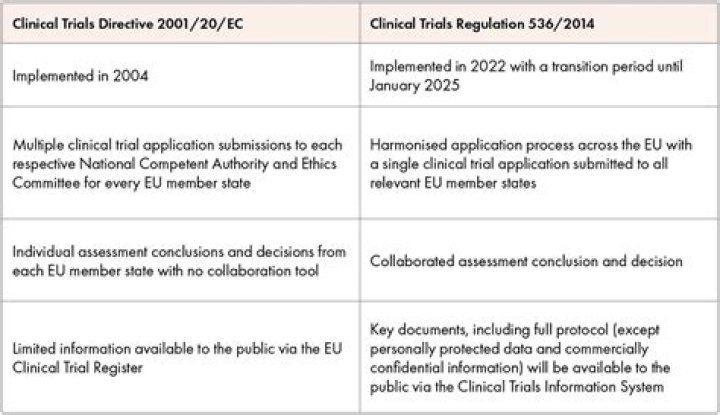
What are the benefits of the EU CTR?
The key benefits of the regulation include:
- Harmonized electronic submission and assessment process for clinical trials conducted in multiple Member States.
- Improved collaboration, information-sharing and decision-making between and within Member States.
- Increased transparency of information regarding clinical trials.
What are clinical trial regulations?
The Clinical Trials Regulations cover only investigations/studies which are undertaken to ascertain the efficacy or safety of a medicine in human subjects. Non-interventional trials are excluded from the Regulations.
What is the EU Cookie directive?
EU Cookies Directive. The Cookies Directive was adopted as an amendment to the e-Privacy Directive in May of 2011 by all countries in the EU. Websites that are either owned by EU businesses or directed towards EU citizens must inform visitors that cookies are in use, how these cookies are used, and obtain consent before cookies can be used.
What is clinical trial authorization?
Clinical Trial Authorization (CTA) is mandatory to conduct clinical trials in humans. CTA can only be obtained after submission of a group of scientific documents in the form of Investigational Medicinal Product Dossier (IMPD).
What is clinical trial therapy?
Clinical trials are research studies that help doctors determine whether a gene therapy approach is safe for people. They also help doctors understand the effects of gene therapy on the body. Your specific procedure will depend on the disease you have and the type of gene therapy being used.