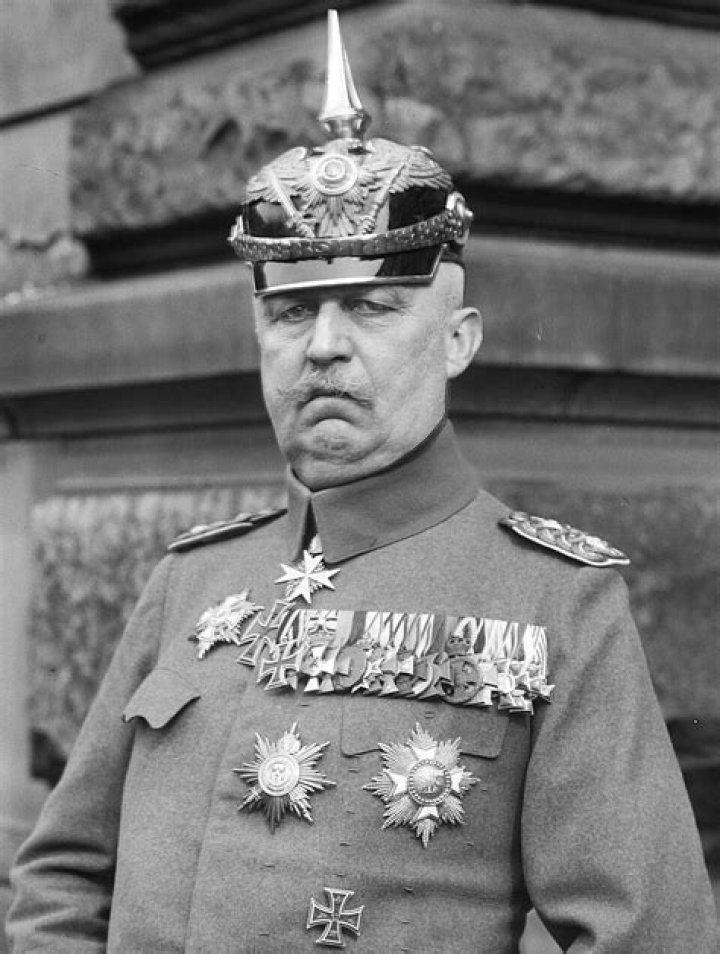
Who was Ludendorff and what did he do?

Christopher Lucas
Published Jul 12, 2026
Who was Ludendorff and what did he do?
General Erich Ludendorff (1865-1937) was a top German military commander in the latter stages of World War I. Educated in the cadet corps, Ludendorff was named chief of staff to the Eighth Army after the outbreak of war and earned renown for the victory at the Battle of Tannenberg.
What happened to Ludendorff?
Ludendorff participated in an unsuccessful Nazi coup in Munich in 1923, and in 1925 ran for president against Hindenburg, now a bitter enemy. From 1924 to 1928 he was a Nazi member of the Reichstag. After falling out with the Nazis he retired and died on 20 December 1937.
Why did Ludendorff offensive fail?
The Spring Offensives failed for several reasons. There were serious command errors. Ludendorff squandered his best chance at victory by missing British logistical vulnerabilities, and he lost a grip on the operations, repeatedly reinforcing mere tactical successes.
What was the spring offensive in ww1?
The German spring offensive, or Kaiserschlacht (“Kaiser’s Battle”), also known as the Ludendorff offensive, was a series of German attacks along the Western Front during the First World War, beginning on 21 March 1918. There were four German offensives, codenamed Michael, Georgette, Gneisenau, and Blücher-Yorck.
Why did Ludendorff hand over power to the Reichstag in 1918?
Ludendorff wanted Germany to remain an aggressive and militaristic nation. he persuaded Wilhelm II to dismiss anyone senior figure who talked of defeat or even of a negotiated peace settlement. With Hindenburg, Ludendorff transferred power back to the Reichstag in September 1918, and called for a peace settlement.
Was Ludendorff a dictator?
In the years 1916 to 1923 Ludendorff ruled as de-facto dictator of the German Empire until his arrest and resignation following the Osthilfeskandal in 1923.
What is Ludendorff based on?
Fargo
Influence. Ludendorff may be based on the eastern area of Fargo, the largest city of North Dakota, with the landmark cinema in town being a replica of the Fargo Theater.
What was the result of Kaiserschlacht?
The British lost 236,000 men between 21 March and 29 April 1918 however the nature of the losses was unusual in that relatively few soldiers were killed (but still 20,000) while many were lost in action (120,000), for the most part taken prisoner.
What was the outcome of Germany’s last offensive?
The Battle of the Bulge marked the last German offense on the Western Front. The catastrophic losses on the German side prevented Germany from resisting the advance of Allied forces following the Normandy Invasion. Less than four months after the end of the Battle of the Bulge, Germany surrendered to Allied forces.
Where was the Ludendorff offensive?
France
West Flanders
Spring Offensive/Locations
What rank was Ludendorff?
General der Infanterie
Erich Ludendorff
| General der Infanterie Erich Ludendorff | |
|---|---|
| Years of service | 1883–1918 |
| Rank | General der Infanterie |
| Battles/wars | World War I German Revolution |
| Awards | Pour le Mérite Iron Cross First class |
What was the Ludendorff’s plan?
Ludendorff’s plan of a general offensive against Russia by means of a temporary reduction of the German forces in the west did not receive approval by the supreme army command in the summer of 1915.
Why did Ludendorff’s offensives fail in WW2?
However, the offensives were an utter operational and strategic failure. One of the main reasons is the inability of Ludendorff to follow the stated operational aims. Indeed, Ludendorff ordered assaults that did not serve the initial operational and strategic objectives, objectives he lost sight of.
How effective were the German offensives of March-July 1918?
The German offensives of March-July 1918 demonstrated the German ability to achieve great tactical success. By mid-July 1918, the territory controlled by the German Empire stood at its greatest ever extent, coming close to Paris. [30] However, the offensives were an utter operational and strategic failure.
What was the result of the Hundred Days Offensive?
The ensuing Hundred Days Offensive resulted in the Germans losing all of the ground that they had taken in the Spring Offensive, the collapse of the Hindenburg Line, and the capitulation of Germany that November. Comparative numbers of German and Allied front-line infantry from April to November 1918.